


I spent last Tuesday watching a senior recruiter build a Boolean string. Twenty-three minutes of careful nesting—parentheses balanced, operators capitalized, synonyms stacked like bricks. She hit search. Forty-seven results. Eleven were relevant. She sighed, deleted a clause, added two synonyms she'd forgotten, and tried again. This is supposed to be the high-skill version of talent acquisition.
Published by Mokka, an AI recruiting platform covering sourcing, screening with AI pre-interviews, and candidate profile integrity. We write about the problems our product addresses, so weigh the analysis accordingly.
That scene plays out in recruiting departments every day, and it represents an economic problem hiding in plain sight. Recruiters spend 30-40% of their working hours on manual sourcing and screening according to SHRM's 2025 State of Talent Acquisition report. We have taken the most expensive, judgment-intensive role in the hiring chain and turned it into data entry with extra steps.
Why Boolean sourcing can't keep up with the 2026 market
Boolean logic itself isn't broken. AND, OR, NOT—these are perfectly sound operators. The problem is the maintenance burden they impose on human recruiters at scale.
Consider what actually happens to a Boolean string over time. A recruiter builds a careful query for a machine learning engineer role: titles, skills, tools, locations. Six months later, that same role might require different frameworks, the market has adopted new terminology, and candidates have updated their profiles with different self-descriptions. Boolean string accuracy degrades by approximately 60% after six months due to job title evolution and skill terminology changes, according to Hiretual and SeekOut's 2025 research.
Stacey Harris, Chief Research Officer at Sapient Insights, put it precisely in a January 2026 interview with HR Executive: "The real problem isn't Boolean itself—it's that human recruiters cannot maintain the thousands of variations needed for comprehensive sourcing at scale."
This is what economists call a coordination problem. The information environment shifts faster than any individual can update their search logic. No single recruiter can track every title mutation—from "ML Engineer" to "Applied Scientist" to "Machine Learning Research Engineer"—across every platform, every week, for every open role. The system demands real-time adaptation that manual methods structurally cannot provide.
The cost shows up in the metrics that matter. Traditional Boolean sourcing produces an average time-to-fill of 42 days, compared to 28 days with AI-assisted sourcing (LinkedIn Talent Solutions 2025). That two-week gap isn't a productivity inconvenience. It's real money—vacancy costs, team overtime, delayed projects, lost revenue.
The anthropology of the Boolean guild
Here's what I find fascinating from an anthropological perspective: Boolean sourcing has become a guild skill. Senior recruiters take pride in their string-crafting abilities. They trade templates like family recipes. There are entire conference tracks at SourceCon dedicated to advanced Boolean techniques.
Guild skills serve the guild, not the organization. When a Boolean-expert recruiter leaves, their knowledge walks out the door with them. The templates remain, but the contextual understanding of why each clause exists—that tacit knowledge vanishes. Junior recruiters then face the dual burden of learning complex Boolean logic while simultaneously hitting hiring targets. Most never reach proficiency before they're expected to deliver results.
This creates what anthropologists recognize as a knowledge-keeping elite—a small group whose specialized knowledge becomes a bottleneck rather than a strategic advantage. The organization doesn't just depend on these individuals; it's vulnerable to their departure.
What an autonomous sourcing agent actually does differently
An autonomous sourcing agent doesn't "write better Boolean." That framing fundamentally misunderstands the technology. What it does is operate on a different search model entirely—one based on semantic understanding rather than keyword matching.
Here's the mechanical difference. Boolean sourcing says: "Find me profiles containing words A, B, or C, excluding D, within 50 miles of this zip code." A sourcing agent says: "Find me people who have demonstrated the capabilities required for this role, including those who describe their work differently than I might expect, and rank them by likely fit."
The agent processes 10,000+ candidate profiles in under two hours, compared to the 50-100 a recruiter can review manually (industry benchmark data, 2025). But speed isn't the point. The point is what it's looking for.
Vector embeddings allow the agent to understand that a candidate who lists "building predictive models in Python" and another who writes "developing ML pipelines with scikit-learn" are describing overlapping skill sets. Boolean would treat these as separate queries requiring explicit OR operators. A semantic agent recognizes the conceptual proximity automatically.
Jeremy Roberts, Head of Talent Intelligence at a Fortune 500 company, described the shift at SourceCon in September 2025: "We went from 15 Boolean templates per role to an autonomous agent that generates context-aware queries in real-time. Our diverse candidate pipeline increased 47%."
That diversity increase is not coincidental. It's one of the most economically significant features of autonomous sourcing.
The diversity premium
Boolean strings have a structural bias toward the known. You can only include synonyms you've already thought of. You can only search for titles that already exist in your mental model of the role.
This means Boolean systematically under-represents candidates who describe their experience in non-standard ways—people from different industries, career changers, self-taught professionals, international candidates whose resume conventions differ from domestic norms. These are often the same populations that diversify a candidate pipeline.
Autonomous sourcing agents don't eliminate bias—no technology does—but they expand the search aperture beyond what any individual recruiter would construct manually. When Roberts' team saw a 47% increase in diverse candidates, it wasn't because the agent was specifically improving for diversity. It was because the agent was simply finding qualified people that hand-built strings had structurally excluded.
The economics of replacing manual sourcing
Let me walk through the cost structure, because the numbers are stark.
Cost-per-hire with autonomous sourcing: $3,400. With manual Boolean methods: $4,700 (SHRM 2025). That $1,300 difference per hire compounds quickly. An organization making 500 hires per year saves $650,000, not including the downstream effects of faster fills and reduced vacancy costs.
It's about opportunity cost. Every hour a senior recruiter spends building and refining Boolean strings is an hour they're not spending on candidate engagement, hiring manager consultation, offer negotiation, or strategic workforce planning. These are the activities where human judgment creates actual competitive advantage.
Organizations using autonomous sourcing agents report a 3.2x increase in qualified candidate pipeline (Gartner Talent Acquisition Tech Report, Q4 2025). That's not 3.2x more resumes to screen. That's 3.2x more qualified candidates, people who actually meet the criteria. More qualified candidates mean better hiring decisions, which means better retention, which means lower replacement costs downstream.
Madeline Laurano, Founder of Aptitude Research, projected in her 2025 Talent Acquisition Technology Report: "By 2027, we expect 65% of mid-to-large enterprises will have deployed some form of autonomous sourcing. The ROI is becoming undeniable."
The 2026 inflection point
This year is the inflection. 72% of enterprise TA leaders plan to reduce reliance on manual Boolean searches by 2027 (Deloitte Global Human Capital Trends, 2026). The platforms have matured. LinkedIn launched its Sourcing Agent feature in January 2026, automating Boolean string generation and candidate matching directly within Recruiter. SeekOut, Eightfold, Gem, and HireEZ all released autonomous sourcing capabilities between June 2025 and early 2026.
Katherine Jones, former VP Analyst at Gartner, captured the moment clearly at the TA Tech Summit in March 2026: "Boolean strings are like using a phone book in the age of Google. They were essential tools, but autonomous agents represent a fundamental shift in how we discover talent."
The phone book analogy is precise. Phone books weren't wrong, the numbers in them were accurate. They simply couldn't compete with a system that understood what you were looking for and could search the entire landscape in milliseconds.
What recruiters actually do when sourcing is automated
The most persistent anxiety I hear about autonomous sourcing is that it eliminates the recruiter's role. This misunderstands what the technology automates and what it doesn't.
Autonomous sourcing automates search construction and initial screening. It does not automate judgment, relationship-building, or strategic alignment. Here is what a recruiter's workflow looks like when an agent handles sourcing:
- Define the talent problem. What does this role actually require? What are the non-negotiables versus nice-to-haves? What's the market context? This is strategic work that requires deep understanding of the business.
- Calibrate the agent. Provide context, constraints, and feedback on initial results. This is where recruiter expertise directly shapes the search, without requiring Boolean syntax.
- Engage qualified candidates. The agent surfaces people; the recruiter builds relationships. Personalized outreach, candidate experience, selling the opportunity, this is irreducibly human work.
- Advise hiring managers. Interpret the candidate landscape, advise on realistic expectations, enable decision-making. This is consultative, not clerical.
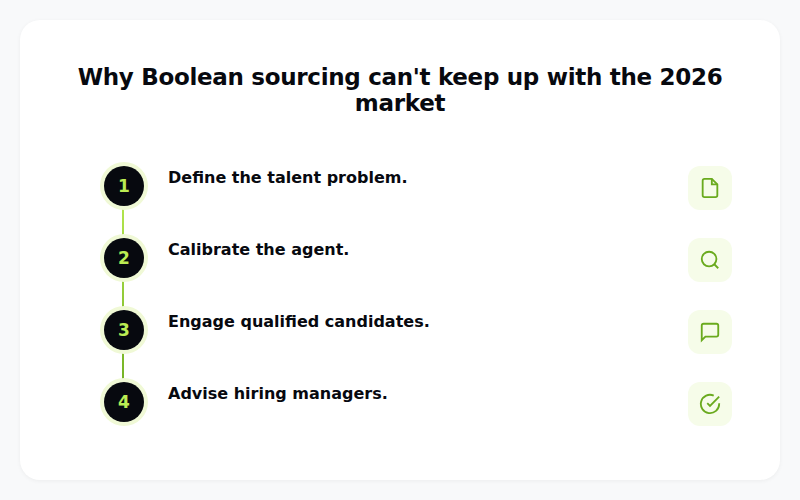
The recruiter becomes a talent strategist rather than a search technician. The skill set shifts from "can you write a complex Boolean string?" to "can you understand what the business needs and recognize it when you see it?"
This is, frankly, a more valuable role. It's also harder to automate.
The junior recruiter question
The legitimate concern is about skill development. If junior recruiters never learn Boolean, do they develop the underlying understanding of how search works, what makes a candidate relevant, how to think about skill adjacencies, when to broaden versus narrow?
I'd argue the opposite happens. When junior recruiters aren't spending their first year mastering syntax, they're spending it on higher-cognitive tasks earlier. They learn to evaluate candidate fit by evaluating candidates, not by constructing queries. The agent becomes a teaching tool, it surfaces results, the recruiter assesses them, and the feedback loop builds understanding faster than Boolean debugging ever did.
Gem's AI-powered sourcing agent, announced in September 2025, explicitly learns from recruiter feedback, improving candidate relevance scores by 34% over six months. Each calibration teaches both the agent and the recruiter.
The Monday morning framework
Here's the mental model I'd propose for any TA leader reading this in 2026. Think of your sourcing stack in three layers:
Layer 1: Autonomous search. The agent handles query construction, semantic matching, multi-platform sourcing, and initial relevance scoring. This is automated. It should be. Humans are not the best tool for this job anymore.
Layer 2: Human calibration. Recruiters provide context, set constraints, review agent outputs, and give feedback. This is where domain expertise translates into search quality. The agent is only as good as the human judgment guiding it.
Layer 3: Human connection. Recruiters engage candidates, build relationships, advise hiring managers, and close offers. This is where the economic value of a recruiter actually resides. Every hour you free from Layer 1 is an hour you can invest in Layer 3.
The organizations winning at hiring right now aren't the ones with the most complex Boolean templates. They're the ones who have correctly identified which parts of sourcing are a computation problem and which parts are a judgment problem, and have assigned each to the right type of intelligence.
Boolean isn't dead as a concept. Logical operators still underpin how databases work. But the craft of hand-building search strings, sitting at a desk for twenty minutes nesting parentheses and guessing at synonyms, that's a phone book in a Google world. The recruiters who thrive in 2026 and beyond will be the ones who stop writing queries and start having conversations.