


The average US talent sourcer earns between $72,000 and $95,000 a year. For that investment, the personalized, carefully crafted outreach they send pulls a response rate of just 2.8%. We have built an expensive, exhausting pen-pal operation and disguised it as a relationship discipline. It is time to look at what sourcing actually does rather than what we prefer to believe it means.
Published by Mokka, an AI recruiting platform covering sourcing, screening with AI pre-interviews, and candidate profile integrity. We write about the problems our product addresses, so weigh the analysis accordingly.
The $90,000 Bottleneck Hiding in Plain Sight
The talent acquisition industry clings to a romantic orthodoxy: sourcing is a human-first discipline built on connection. It is a comforting narrative, but the economics tell a different story. At enterprise scale, a dedicated sourcer supporting three to five recruiters is expected to deliver eight to fifteen qualified candidates a week. To meet that quota, they juggle hundreds of active LinkedIn conversations simultaneously.
This manual coordination creates a severe bottleneck. Recruiters wait days, or even weeks, for sourcers to manually nurture candidates who were often ready to interview the moment they applied. The result is a bloated sourcing-to-interview handoff. According to Greenhouse hiring benchmarks, candidate drop-off increases 1.5x for every additional week spent in this limbo. We are losing perfectly good hires because we insist on inserting a manual relationship phase where none is needed.
The average cost-per-hire in the US reached $4,700 in 2025, up from $4,129 in 2023 (historical context), according to SHRM data. Time-to-fill remains stubbornly high at 41 to 44 days. TA leaders sense a massive ROI problem but often lack the framework to articulate it to their CFOs. They feel the friction of growing sourcer headcount that yields zero improvement in time-to-fill.
"The industry conflated personalization with connection. Writing someone's name in a template isn't a relationship — it's theater that costs $90K a year." — Johnny Campbell, SocialTalent
The math is unforgiving. When a $90,000-a-year role is dedicated to managing a 2.8% response rate, we are no longer talking about human connection. We are talking about unscalable logistics masquerading as relationship-building.
Sourcing Is Signal Extraction, Not Charisma
If we strip away the sentimentality, what does a sourcer actually do? They parse massive datasets to identify patterns, extract viable signals from a noisy market, and route those signals to the correct hiring manager. It is a data and systems problem.
Glen Cathey, SVP at Randstad, has repeatedly argued that the best sourcers are information architects, not correspondents. The job is to filter a market of millions down to a precise shortlist. The outreach itself—the part we romanticize as "relationship-building"—is simply the routing mechanism that triggers the next step in the funnel.
Viewed through an economic lens, the current manual model suffers from a catastrophic misallocation of labor. We are paying a premium for human effort in a phase of the hiring pipeline where candidates explicitly want speed and transparency. A candidate does not want a pen-pal; they want to know if the role fits their compensation expectations and timeline. When a human steps in to "nurture" that transaction, they introduce latency, bias, and human error.
Jer Tung of HireEZ argued at HR Tech 2025 that the moment you try to make sourcing a relationship role, you have created an unscalable operation. The market is proving him right. According to the HireEZ 2025 benchmark report, organizations adopting AI sourcing tools have reduced the time required to identify qualified candidates by 40 to 60%.
The Anthropology of the "Relationship" Myth
Why does the talent industry fight so hard to preserve the relationship narrative? Anthropology offers a clue. Rituals often persist long after their original economic utility has vanished. They serve to reinforce group identity and social cohesion. In modern talent acquisition, "human connection" has become a totem—a sacred concept that justifies the existence of a role, even as the underlying work shifts to data processing.
Sourcers themselves report alarming rates of burnout from managing hundreds of dead-end conversations. The "relationship" model is exhausting them. Meanwhile, internal mobility and referral hires consistently outperform cold sourced hires on retention by 25 to 30% at the two-year mark. The data suggests that the deep relationships a company needs are already inside its own walls, or within its immediate network. Cold outbound sourcing is, and always has been, a logistics exercise.
Hung Lee of Recruiting Brainfood wrote in March 2026 that we have to stop pretending a three-message LinkedIn exchange constitutes a relationship. Sourcing is logistics, and logistics should be automated. The pushback against this idea comes from a fear of dehumanizing the candidate experience. But forcing a candidate into a multi-week, manual nurturing sequence with an overwhelmed sourcer is the true dehumanization.
Routing Logic Replaces Relationship Theater
The market is already correcting the bottleneck. In late 2025, LinkedIn launched its AI sourcing agent, which autonomously identifies, ranks, and drafts outreach. Crucially, LinkedIn explicitly positioned the sourcer role as a "curator and router" rather than a relationship builder.
This is not a niche experiment. 72% of talent acquisition leaders reported investing in AI sourcing automation in 2025, a massive jump from 48% in 2023 (historical baseline). The shift is accelerating because the output quality is undeniable.
The Ashby 2025 hiring intelligence report demonstrated that companies using automated sourcing-to-interview routing achieve a 38% faster time-to-fill than those relying on manual sourcer-driven relationship nurturing. Faster pipelines mean lower operational costs and less candidate drop-off.
The most aggressive validation of the routing-layer model comes from the AI companies themselves. In early 2026, OpenAI and Anthropic released case studies showing their recruiting ops teams use LLM-based routing to replace manual sourcer screening. The result? Candidate-to-interview time dropped from 9 days to 1.5 days.
When the companies building the most advanced AI in the world choose routing logic over human relationship-building for their own hiring, the debate is effectively over.
The Market Revalues the Sourcer Role
The economic implications are rippling through the labor market. The UK's REC and the US-based ASA published 2025 salary surveys in Q1 2026 showing that traditional sourcer compensation is plateauing. Conversely, "sourcing ops" roles—specialists who manage AI tools, tune routing logic, and audit datasets—command a 15 to 20% premium.
This is a clear market revaluation. The premium for human charisma has evaporated. The new premium is on systems thinking.
Enterprise TA teams are acting accordingly. In Q4 2025, companies like Dropbox and Notion restructured to eliminate dedicated sourcer roles. They replaced them with sourcing ops specialists who manage algorithms rather than inboxes. Recruiters at these companies report higher satisfaction and faster pipelines, though many still fear the social taboo of saying so publicly. The orthodoxy of "human connection" is powerful, and admitting that you prefer automated routing feels like a violation of TA community norms.
But the orthodoxy is crumbling under economic pressure. The Gem 2025 State of Sourcing Report revealed that response rates to personalized outreach have declined for the third consecutive year, falling from 7% in 2022 to 2.8% in 2025. Candidates are immune to the theater of personalization. They ignore it because the underlying routing mechanism—a manual human trying to manage hundreds of threads—is fundamentally broken.
The Monday Morning Mental Model
The sourcer-as-router framework requires a mental shift. Stop evaluating your sourcing team on the volume of messages sent or the "depth" of their candidate conversations. Start evaluating them on the speed and accuracy of their signal routing.
Here is the model to apply Monday morning:
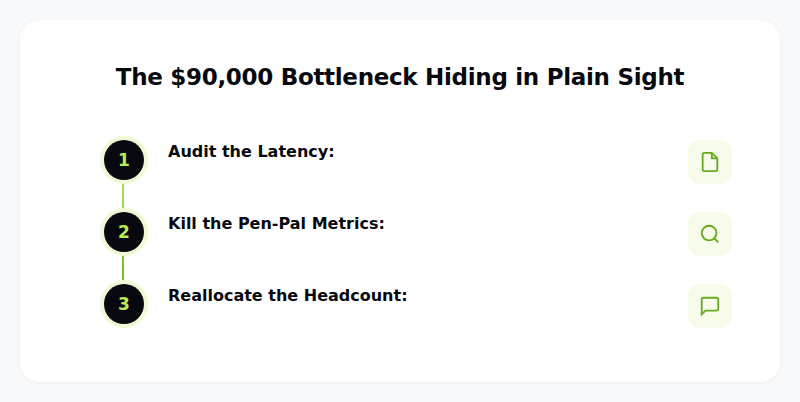
- Audit the Latency: Pull the data on your sourcing-to-interview handoff. If a candidate who expresses interest today is not on a hiring manager's calendar within 48 hours, your routing layer is broken. You are losing candidates to friction.
- Kill the Pen-Pal Metrics: Stop tracking messages sent or response rates on manual outreach. These are vanity metrics that prop up the relationship theater. Track time-to-identify and time-to-interview instead.
- Reallocate the Headcount: Do not fire your sourcers; retool them. The market is paying a 20% premium for sourcers who can write Boolean strings, tune AI parameters, and audit routing logic. Move your team from correspondence to systems architecture.
Katherine Van Kirk of Ashby noted in a January 2026 podcast that the sourcer-as-relationship-builder model breaks down completely at scale. You end up with 200 active conversations and zero hires. The math of human attention simply does not scale.
The talent industry must abandon the fiction that a cold outreach sequence is a relationship. Relationships are built by hiring managers during the interview process, and by managers during the employee's first year. Sourcing is the routing layer that gets the right signals to those humans as fast as mechanically possible. The moment we stop confusing logistics for intimacy is the moment our pipelines finally move.