

I've watched three dozen recruiting teams evaluate AI sourcing tools this year, and the pattern is always the
| Tool | Starting price | Best for | Key feature | Limitation |
|---|---|---|---|---|
| Findem | Custom pricing | Talent market intelligence | Attribute-based search that infers candidate qualities from career trajectory, company performance, and market signals | Outreach capabilities feel bolted onto an analytics platform with personalization relying on data attributes rather than conversational context |
| Juicebox | Custom pricing | Aggregation power and agentic workflows | Searching 800M+ profiles across 30+ data sources with agentic learning that improves based on outcomes | Agent behavior is constrained by the assumptions built into the original search-first architecture |
same: they demo well, then collapse under real hiring conditions. The problem isn't the technology. It's that most tools automate the wrong part of the workflow.
Published by Mokka, an AI recruiting platform covering sourcing, screening with AI pre-interviews, and candidate profile integrity. We write about the problems our product addresses, so weigh the analysis accordingly.
The honest distinction in 2026 is between platforms that help you search faster and agents that actually engage candidates without you. That gap matters more than any feature checklist.
What end-to-end actually means in AI sourcing
The phrase "end-to-end automation" has become meaningless through overuse. Vendors slap it on everything from Boolean search helpers to full workflow engines. So let me define it operationally: end-to-end means the tool handles everything from candidate identification through initial conversation without a recruiter touching the keyboard.
Most tools calling themselves "end-to-end" in 2026 stop at the list. They find people, maybe rank them, then hand you a spreadsheet and a "compose" button. That's not automation. That's a faster horse.
The recruiting market is sorting itself into three tiers right now:
- Search accelerators — better filters, wider data, faster results, but you still write every message
- Semi-autonomous platforms — AI drafts outreach, you approve and send, some sequencing logic
- Autonomous sourcing agents — you define the role and parameters, the agent identifies, engages, and converses with candidates until a qualified prospect is ready for human handoff
This third category didn't really exist in production-grade form until late 2025. Now it's the most interesting battleground in recruiting technology.
Findem: talent intelligence that stops at the shortlist
Findem built its reputation on what it calls "attribute-based search" — instead of matching keywords on a resume, it infers candidate qualities from career trajectory, company performance, and market signals. The premise is economically sound: a recruiter searching for "growth marketer" gets very different results if the tool understands that someone who scaled a startup from $2M to $20M ARR has fundamentally different experience than someone who managed paid campaigns at a Fortune 500 brand.
The platform's 2025 expansion into more comprehensive autonomous sourcing features (October 2025) was a recognition that intelligence without action is incomplete. Findem now offers outreach automation, but its core DNA is still analytical — it tells you who to target and why, with considerably less investment in the actual conversation that follows.
Where Findem excels is talent market intelligence. If you're a recruiting leader building a hiring plan and need to understand candidate supply, compensation benchmarks, and competitor movement patterns, it's genuinely useful. The attribute-based approach does produce better shortlists than keyword matching. LinkedIn's 2025 data showing that 73% of recruiters found AI improved their speed to qualified candidates likely includes a large share of this kind of intelligence-layer tool.
Where Findem underwhelms is the last mile. The outreach capabilities feel bolted onto an analytics platform. Personalization relies on data attributes rather than conversational context. You get a better list, but you're still doing the work of turning that list into relationships.
Juicebox: aggregation power meeting agentic ambition
Juicebox entered 2026 with the most aggressive positioning shift in the market. Their January launch of "Juicebox Agents" was a clear signal that they see autonomous workflows as the future — and that their previous model of AI-assisted search was a stepping stone, not a destination.
The numbers behind Juicebox's aggregation layer are genuinely impressive. Searching 800M+ profiles across 30+ data sources (Juicebox 2026) gives their agents a wider hunting ground than most competitors. Their AI-powered sequencing claims up to 3x more replies compared to traditional outreach, which aligns with what we'd expect from systems that improve send timing, subject lines, and follow-up cadences based on response pattern data.
The agentic learning capabilities announced in January 2026 are the interesting part. Juicebox Agents are designed to improve their sourcing and outreach based on outcomes — which candidates respond, which conversations lead to interviews, which sequences convert. This is the right architectural instinct. Static automation degrades over time as candidates adapt their inboxes to filter generic AI messages. Learning systems at least have a chance of staying ahead of that adaptation.
The limitation I see is architectural. Juicebox built a massive search and aggregation engine first, then layered agents on top. The agent behavior is constrained by the assumptions built into the original search-first architecture.## The autonomy spectrum: assist vs. automate
Here's the framework I use when evaluating these tools, borrowed loosely from the levels of autonomy in self-driving vehicles:
Level 0 — Manual search, manual outreach (traditional LinkedIn Recruiter) Level 1 — AI-assisted search, manual outreach (Boolean generators, Chrome extensions) Level 2 — AI search + AI-drafted messages, human approval required (most "AI sourcing" tools in 2024-2025) Level 3 — Autonomous identification and outreach with human monitoring and escalation Level 4 — Fully autonomous sourcing through qualified candidate handoff
Findem sits between Level 2 and Level 3, strong intelligence, improving outreach, but still oriented around the recruiter as operator. Juicebox is making a serious run at Level 3 with their Agents launch, though the product is young enough that real-world performance data is thin.
The industry analysis from 2025 showing autonomous sourcing agents handling 70-80% of initial candidate engagement without human intervention describes what Level 3-4 looks like in practice. That's not a future projection. That's what production systems are doing right now for high-volume, well-defined roles.
Why autonomous outreach is the hardest and most valuable problem
The recruiting industry has spent decades improving the top of the funnel. Better job boards, better search algorithms, better Boolean, all of it aimed at helping recruiters find more candidates faster. And it worked. The average time-to-hire dropped by 35% with AI sourcing tools versus manual methods (Gartner 2025), and cost-per-hire fell 20-30% through automation of initial screening and outreach (SHRM 2025).
** Finding candidates is a largely solved problem. Engaging them, getting a human being to read a message, believe it's meant for them specifically, and invest time in a conversation, is where the system breaks down.
This is why autonomous outreach is both harder and more valuable than autonomous search. Search operates on data. Outreach operates on trust. A candidate receiving a message is making a micro-social calculation: Is this person real? Do they know who I am? Is this worth ten minutes of my life?
Generic AI outreach fails this test immediately. Candidates in 2026 have been bombarded with automated messages for two years. Their filters, both technical (spam rules) and psychological (pattern recognition for template language), are sophisticated. The SHRM data on cost reduction is real, but it masks a growing problem: response rates to AI-generated outreach are declining even as the tools improve, because the recipients are adapting faster than the senders.
Effective autonomous outreach has to clear a higher bar than "personalized at scale." It has to demonstrate contextual awareness, not just inserting the candidate's name and company, but showing understanding of their career trajectory, their likely motivations, and why this specific opportunity is worth their attention right now.
The integration question nobody answers honestly
Every tool in this space claims smooth ATS integration. Here's what that actually means in practice:
Findem integrates well with major ATS platforms for data flow, candidate profiles, status updates, analytics dashboards. If your primary workflow is "find candidates, add them to a project, push to ATS," the integration is solid.
Juicebox has invested heavily in ATS/CRM connectivity as part of their enterprise push. The 2025-2026 trend of major ATS platforms building native autonomous sourcing features (Q4 2025 through Q1 2026) both helps and competes with standalone tools like Juicebox. When Workday or Greenhouse builds sourcing agents natively, the integration advantage of third-party tools diminishes.
The honest assessment: integration quality varies wildly by ATS version, implementation, and the specific workflows you're trying to automate. Nobody should make a buying decision based on integration claims without testing it against their actual tech stack.
Data quality as the hidden variable
The HR Technology Conference caution in 2025 about AI sourcing effectiveness depending heavily on data quality is the most underdiscussed factor in this entire market.
Findem's attribute-based approach is an attempt to solve this, if you can infer qualities from patterns rather than relying on self-reported resume data, you're less vulnerable to outdated or incomplete profiles. It's a good architectural choice, but it's still dependent on the underlying data sources being current and accurate.
Juicebox's 30+ source aggregation theoretically reduces single-source dependency, but aggregation without curation creates its own problems. Duplicate profiles, conflicting data points, and outdated information multiply when you're pulling from dozens of sources without a strong reconciliation layer.
The autonomous agents that will win are the ones that can detect when their data is wrong. A system that confidently sends personalized outreach based on stale information is worse than a system that flags uncertainty and asks for human input. Humility in AI is an underappreciated feature.
The economics of autonomy vs. assistance
Deloitte's 2025 finding that 67% of talent acquisition leaders plan to increase investment in AI recruiting tools in 2026 tells you where the budget is flowing. But the ROI calculation looks different depending on where you sit on the autonomy spectrum.
Assisted tools (Levels 1-2) deliver ROI through recruiter productivity. If a tool saves a recruiter 10 hours per week on sourcing, you can calculate the value based on recruiter cost. The math is straightforward but bounded, you're making expensive human labor slightly more efficient.
Autonomous tools (Levels 3-4) deliver ROI through capacity multiplication. An autonomous agent doesn't save a recruiter 10 hours, it adds the equivalent of a full sourcing function that operates continuously. The economics shift from cost reduction to revenue generation: more qualified candidates in the pipeline, faster fills, reduced vacancy costs.
The threshold question for any TA leader in 2026 is: are you trying to make your current team faster, or are you trying to fundamentally increase your hiring capacity? The answer determines which tier of tool you should be evaluating.
A decision framework for 2026
If you're comparing these tools, or the dozen others entering this space, here's the mental model I'd use:
Step 1: Audit your actual bottleneck. If your recruiters are strong at engagement but drowning in search, a talent intelligence tool like Findem may be the right investment. If your sourcing is efficient but response rates are low, autonomous outreach is where you'll see the highest return.
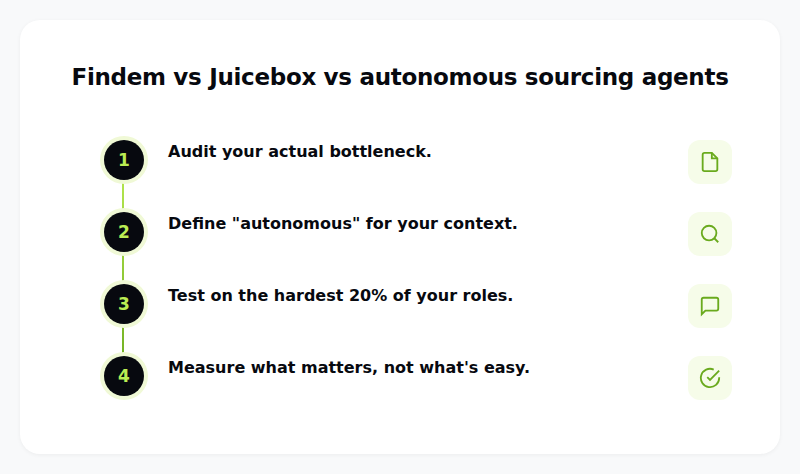
Step 2: Define "autonomous" for your context. What decisions are you comfortable delegating to an agent? Initial candidate identification? Outreach messaging? Follow-up sequences? Conversation through qualification? The answer varies by role seniority, company brand, and candidate market.
Step 3: Test on the hardest 20% of your roles. Every tool works well on high-volume, low-complexity searches, software engineers with clear skill sets, sales reps with defined experience levels. The real test is whether the tool can handle your nuanced searches: senior leadership roles, cross-functional positions, candidates who aren't actively looking.
Step 4: Measure what matters, not what's easy. Response rates are easy to measure and mostly meaningless. Conversation-to-interview conversion rates tell you more. Time-to-qualified-candidate is better than time-to-hire for evaluating sourcing tools specifically.
The recruiting technology market in 2026 is genuinely exciting in a way it hasn't been since the first wave of applicant tracking systems. The tools are moving from helping recruiters do work to doing work that previously required recruiters. That's not a small distinction, it's the difference between a calculator and an accountant.
Choose based on what you actually need automated, not what has the most impressive demo. The best tool is the one that handles the work you least want your humans doing, so they can focus on the work that only humans can do.