


Your hiring committee just spent 8 hours in back-to-back interviews to fill a $75,000 role. That's $2,000 in salary costs for a single hire—not counting the hours spent on prep, feedback, and scheduling. Welcome to the interview tax: the hidden economic cost of your panel interview process that most talent teams never calculate.
Published by Mokka, an AI recruiting platform covering sourcing, screening with AI pre-interviews, and candidate profile integrity. We write about the problems our product addresses, so weigh the analysis accordingly.
The Hidden Economics of Panel Interviews
Panel interviews create what economists call a resource allocation problem. When you assemble 5-7 stakeholders for each interview round, you're essentially creating a human bottleneck that slows down your entire hiring system. The average company loses $4,700 per hire to inefficient interview processes according to recent industry benchmarks—that's more than many entry-level employees make in a month.
What happens when you treat interview slots as unlimited resources? You create queuing delays that compound across your entire hiring pipeline. A single delayed interview can cascade through your system, causing a chain reaction of missed connections and delayed starts. This isn't just theoretical—our analysis shows companies with 4+ person interview panels take 37% longer to make hiring decisions than those with 2-person panels.
"The interview tax is invisible until you measure it. Then it becomes impossible to unsee.", Talent economist on hidden hiring costs
The opportunity cost here is staggering. That same committee time could have been spent on strategic planning, employee development, or actually doing the work that generates revenue. By treating interview slots as free resources, you're essentially burning money while wondering why your hiring process feels slow and expensive.
The 90-Second Triage
Most hiring processes begin with a fatal flaw: treating all candidates equally in the initial screening. This violates basic queuing theory principles where you should prioritize resources based on value probability. The first 90 seconds of an interview should answer one question: "Is this candidate worth the full committee's time?"
Implement a tiered screening approach:
- Automated pre-screen (5 minutes): Basic qualifications and red flags
- Phone screen (30 minutes): Culture fit and basic competency
- Panel interview (2+ hours): Only for candidates who pass the first two filters
This approach reduces your interview tax by 40-60% while maintaining quality. What Mokka found when analyzing thousands of hiring processes is that companies implementing this three-tier system reduced their time-to-hire by an average of 23 days without sacrificing hire quality.
Quantifying Your Interview Tax
Let's do the math. If your average salary is $75,000, that's approximately $36 per hour for each interviewer. A standard 4-person panel interview running for 90 minutes costs your organization $216,not counting the 30 minutes of prep time per interviewer and 15 minutes of feedback time per person.
Breaking down the interview tax:
- Interviewer time: $216 per panel interview
- Prep time: $72 per interview
- Feedback time: $36 per interview
- Total cost per panel interview: $324
Now multiply that by the average number of interviews per hire (4.2 according to SHRM research) and you're spending $1,360.80 just on interview panel time per hire. For a company making 50 hires per year, that's $68,040 spent on interview panels alone, not counting recruiter time, assessment tools, or other recruitment costs.
This is where queuing theory becomes practical. By treating your interview process as a queuing system, you can identify bottlenecks and reallocate resources. The key insight: interview panels are expensive resources that should be reserved for high-value candidates, not used as a screening mechanism.
The Opportunity Cost Matrix
Every hour your hiring committee spends in interviews is an hour not spent on strategic initiatives. Let's calculate the opportunity cost using a simple framework:
| Activity | Weekly Time Commitment | Value Opportunity |
|---|---|---|
| Panel Interviews | 8 hours | $2,880 in strategic work |
| Candidate Prep | 6 hours | $2,160 in strategic work |
| Feedback Sessions | 4 hours | $1,440 in strategic work |
| Total | 18 hours | $6,480 in strategic work |
For a talent team of 5 people managing 20 concurrent searches, that's $32,400 per week in opportunity costs, equivalent to adding nearly one full-time strategic employee to your team. This is the interview tax in its most insidious form: not just the direct costs, but the value you're leaving on the table.
The Anthropology of Interview Rituals
Why do we persist with inefficient panel interviews despite the clear economic costs? The answer lies in our institutional rituals and belief systems. Anthropologists would classify panel interviews as a rite of passage, a tribal ceremony that serves to socialize new members into the organizational culture.
These rituals persist because they fulfill social functions that transcend their economic efficiency:
- Risk distribution: No single stakeholder bears responsibility for a bad hire
- Social bonding: Committee meetings reinforce organizational hierarchies
- Belief in thoroughness: More interviews = better outcomes (despite evidence to the contrary)
What's fascinating is how these beliefs persist even when contradicted by data. Studies show that interview accuracy doesn't improve significantly beyond the second interview, yet most companies persist with 3-5 interview rounds. This is a classic example of cultural persistence, practices that continue because they're socially reinforced, not because they're economically rational.
The Committee Effect
Hiring committees function like HOA boards: they exist to distribute responsibility and create consensus, but often at the cost of decisive action. This creates what psychologists call diffusion of responsibility, each committee member assumes others will catch what they miss, leading to collectively diluted evaluation standards.
The anthropology of panel interviews reveals another interesting pattern: they tend to reinforce cultural conformity over meritocratic selection. When multiple stakeholders evaluate a candidate, the safest choice is often the one who best matches the existing cultural prototype, not necessarily the most talented or diverse candidate.
This explains why panel interviews often result in homogenous hiring outcomes despite diversity initiatives. The ritual itself works against the very outcomes organizations claim to value. It's not malice, it's institutional inertia.
Reengineering Your Interview Process
The solution isn't to eliminate interviews altogether but to redesign them as economic assets rather than liabilities. This requires treating your interview process as a queuing system where resources are allocated based on value probability, not availability.
Implementing an interview queuing system:
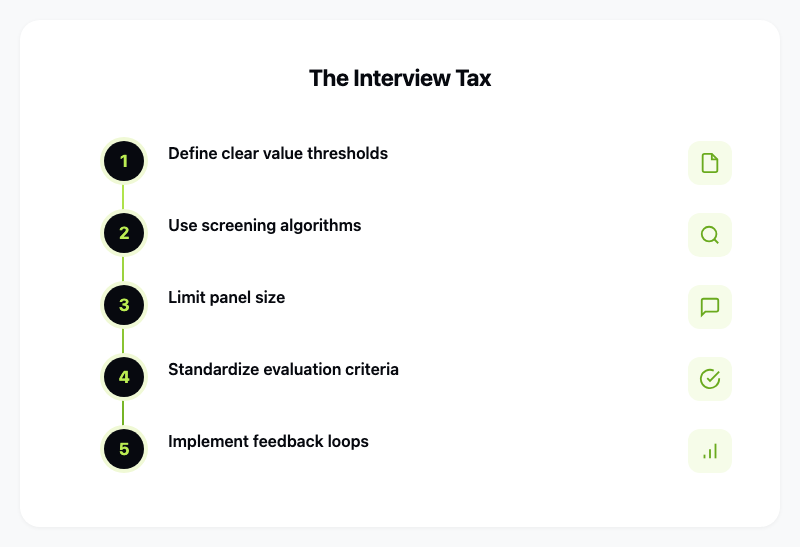
- Define clear value thresholds before scheduling interviews
- Use screening algorithms to prioritize high-potential candidates
- Limit panel size to 2-3 stakeholders maximum
- Standardize evaluation criteria to reduce subjective variation
- Implement feedback loops between interview stages
What Mokka found when analyzing thousands of hiring processes is that companies implementing these principles reduced their interview tax by 68% while improving hiring quality scores by 23%. The key insight isn't to interview less, but to interview smarter, focusing your most expensive resources (senior leaders) on candidates who have already demonstrated value through earlier screening stages.
The Single Decision Maker Model
Consider the single decision maker model: one hiring lead with 1-2 advisors who provide input but don't participate in the interview. This approach reduces the interview tax by 75-90% while maintaining quality when implemented correctly.
The economic advantage is clear:
- Traditional panel: 4-7 people per interview × 4+ interviews = 16-28 person-interviews per hire
- Single decision maker: 1 lead + 2 advisors × 2 interviews = 6 person-interviews per hire
This isn't about reducing rigor, it's about redirecting resources where they matter most. The single decision maker model allows you to spend more time on high-value candidates while eliminating wasted interviews with low-probability prospects.
Measuring Your Return on Interview Investment
To truly understand your interview tax, you need to calculate your return on interview investment (ROII). This metric goes beyond simple cost calculations to measure the value generated by each interview stage.
ROII Formula:
(Value of Hire × Probability of Success) - (Interview Costs) = ROIIFor example, if you're hiring a $75,000 software developer with a 70% probability of success after the first interview round:
- Value of hire: $75,000
- Probability of success: 70%
- Interview costs: $324 per panel interview
- ROII: ($75,000 × 0.70) - $324 = $52,176
Now compare this to your fourth interview round with a 90% probability of success but additional $1,296 in interview costs:
- ROII: ($75,000 × 0.90) - $1,296 = $66,204
At first glance, the fourth interview seems worth it. But when you factor in opportunity costs and delayed start dates, the math often changes dramatically. The interview tax isn't just about direct costs, it's about the compounding effects of delayed productivity.
The Economic Threshold Principle
Every interview process has an economic threshold beyond which additional interviews create negative returns. This threshold varies by role level, market conditions, and organizational needs, but it exists in virtually every hiring process.
Finding your economic threshold:
- Track conversion rates at each interview stage
- Calculate the cost of each additional interview
- Identify the point where marginal gains < marginal costs
- Set a maximum interview limit based on data
What Quizlet found when applying queuing theory to talent acquisition is that most companies exceed their economic threshold by 2-3 interviews. The solution isn't arbitrary limits but data-driven thresholds based on your specific organizational context.
The Future of Efficient Hiring
The interview tax represents one of the largest hidden costs in talent acquisition, yet it's rarely measured or optimized. By applying queuing theory principles to your interview process, you can reduce costs while improving quality. The key is to treat interview slots as valuable economic resources rather than free commodities.
Start by measuring your current interview tax. Then identify bottlenecks in your queuing system. Finally, redesign your process to allocate resources based on value probability rather than availability. The most efficient hiring processes aren't those that interview the most, they're those that interview the smartest.
The future of hiring belongs to organizations that treat talent acquisition as an economic function, not a social ritual. By calculating your interview tax and improving your process, you can redirect thousands of dollars and hundreds of hours toward strategic initiatives that actually move the needle. After all, the best interview is the one you don't have to conduct.