


Seventy-nine percent of job seekers now use AI tools in their applications, and 72% of employers have deployed counter-AI detection systems to catch them. This AI arms race in hiring is a textbook coordination failure: applications have tripled per posting since the launch of ChatGPT, yet candidate pool quality remains flat. When both sides of a market weaponize technology without a shared trust mechanism, screening costs spiral while matching outcomes stay flat.
This guide is published by Mokka, an AI-powered talent acquisition platform covering sourcing, screening with AI pre-interviews, and candidate fraud detection. We include ourselves alongside competitors and aim to be accurate about both our strengths and limitations.
Measuring the deadweight loss of adversarial hiring
Kelly Services' 2026 Top Hiring Challenges report formally identifies what talent acquisition leaders have felt for two years. Their Chief Talent Officer puts it bluntly: "We're watching a textbook coordination failure unfold — both sides escalate AI usage, but matching outcomes haven't improved. It's pure deadweight loss," according to Kelly Services' 2026 Top Hiring Challenges report.
The numbers validate the framing. Average cost-per-hire reached $5,100 in 2025, with screening costs identified as the primary driver, per SHRM data. The year-over-year increase represents pure friction — recruiters spending more time distinguishing human-written cover letters from machine-generated ones, not evaluating actual capability for the role.
Dr. John Boudreau of USC Marshall frames it as a negative-sum game: "When candidates and employers both weaponize AI, you get an arms race that burns resources without improving the quality of the match," according to a 2025 SHRM talent acquisition study.
Eighty-five percent of TA leaders say the current trajectory is unsustainable. The diagnosis is accurate. But identifying the problem as "too much AI" misses the structural issue. The problem isn't the technology. It's the absence of a coordination mechanism.
Why detection can't win this game
Counter-AI detection is the reflexive employer response to AI-assisted applications — and the response that locks you into the arms race permanently. AI detection tools have a false-positive problem that punishes honest candidates using basic writing assistance. A 2025 ResumeBuilder study found that 48% of hiring managers have accidentally rejected qualified candidates because AI detection tools flagged legitimate formatting assistance as machine-generated, according to a 2025 ResumeBuilder study.
This is the classic security dilemma applied to hiring. In international relations theory, when one state builds defenses, neighboring states perceive a threat and build their own. Each side's defensive action is interpreted as offensive by the other. Trust erodes. Escalation follows. The hiring equivalent: candidates use AI because they assume everyone else is. Employers deploy detection because they assume candidates are gaming them. Both sides are right, which is exactly why the spiral continues.
The EEOC recognized this dynamic in March 2026, issuing updated guidance warning that AI detection tools may create disparate impact risks. The concern: non-native English speakers' applications get disproportionately flagged by detection algorithms interpreting stylistic variation as machine generation. The tool meant to catch fake quality ends up filtering out real diversity.
Harvard Business Review analysts made the same observation in 2025: detection tools erode trust in the entire hiring pipeline because they cannot reliably distinguish between a candidate who used AI to mask incompetence and one who used it to polish legitimate experience.
Josh Bersin's framing is precise: "The real tragedy of AI in hiring isn't the technology itself — it's the lack of coordination. Without a trusted intermediary, every innovation just raises the cost of the same outcome." Detection is not coordination. It's escalation framed as defense.
The candidate side: AI as survival, not advantage
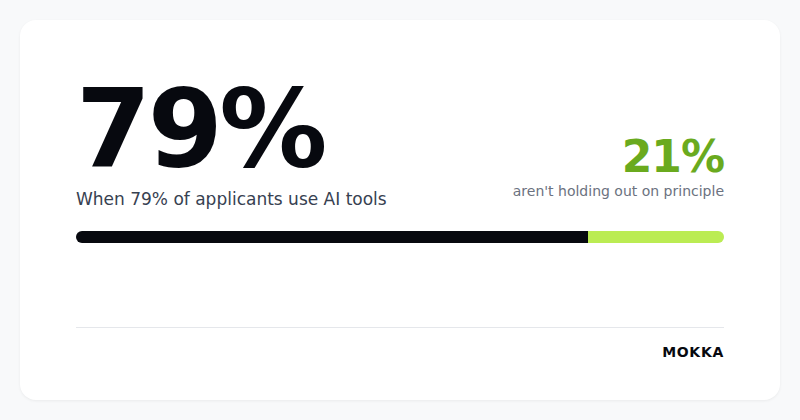
What's happening on the candidate side is rational adaptation to a hostile environment. When 79% of applicants use AI tools, the remaining 21% aren't holding out on principle. They're losing.
A candidate who writes a cover letter from scratch while their competitor uses an LLM to generate five tailored variants in the same timeframe isn't demonstrating superior authenticity. They're demonstrating inferior resource allocation. The market has spoken: AI assistance is table stakes, not a differentiator. Sixty-two percent of recruiters report that AI-generated applications make it harder to identify genuine candidate quality, according to LinkedIn Talent Solutions' 2026 report.
This is Gresham's Law in hiring: bad applications drive out good ones, not because AI-assisted applications are inherently bad, but because the signaling mechanism is broken. When every application looks polished, polish stops signaling competence. When every cover letter is optimized for keywords, keyword optimization stops signaling genuine interest. The information value of the application approaches zero.
Candidates know this. They feel the degradation of the signaling system even if they can't name the economics. They use AI because not using it means getting filtered out by an ATS. They don't expect it to get them hired. They expect it to get them past the machine. The actual hiring decision still happens in the interview, which is why interview-stage assessment is where genuine differentiation still exists.
We're looking at a labor market where the application stage is pure theater — both sides performing for algorithms, neither side extracting information from the exchange. That's the definition of deadweight loss.
How integrity verification breaks the cycle
Every arms race ends the same way: with a coordination mechanism that both sides trust. In nuclear deterrence theory, that was mutually assured destruction plus verification protocols. In trade, it's tariff treaties with enforcement mechanisms. In hiring, it's integrity verification — a shared protocol for establishing authenticity that doesn't require either side to unilaterally disarm.
Mokka's CEO frames the company's integrity verification pillar — delivered through the AI Evaluation Agent, which screens resumes and conducts AI pre-interviews, alongside the AI Sourcing Agent and AI Ranking Agent — in exactly these terms: "Integrity verification breaks the arms race dynamic by establishing a trusted signal layer — neither side needs to escalate when there's a shared protocol for authenticity." Mokka is still a newer entrant, and its ATS integration sits on the Business plan, so a Starter-tier team imports by CSV rather than syncing natively.
The mechanism is straightforward. Rather than asking employers to detect AI-generated content after the fact, integrity verification establishes provenance at the source. Candidates verify their identity, their credentials, and the authenticity of their experience claims through cryptographic attestation. Employers get a verified signal layer that makes detection tools unnecessary. Candidates don't need to perform for algorithms because the verification mechanism handles trust.
This is the "arms control treaty" model applied to hiring. Both sides agree to a verification protocol that makes escalation pointless. Candidates can still use AI tools to polish their communication — that's not the problem. The problem is the inability to distinguish between a candidate who polished real experience and one who fabricated it entirely. Integrity verification solves that distinction without requiring either side to abandon AI tools.
The economics work because verification is cheaper than detection at scale. A one-time attestation of identity and credentials costs less than ongoing investment in detection tools that produce false positives, require constant updates, and create legal risk. The coordination mechanism reduces transaction costs for both sides of the market.
The market is already moving toward coordination
The industry is beginning to recognize that detection is a dead end and coordination is the path forward. LinkedIn announced updates to its recruiter tools in May 2026, adding "authenticity signals" to candidate profiles, a tacit admission that platform-level verification is more valuable than adversarial detection, as highlighted in a 2026 LinkedIn Talent Solutions report.
Greenhouse and Lever both added AI-provenance tagging features in Q1 2026, allowing candidates to voluntarily disclose AI assistance. The framing is transparency norms rather than enforcement, which is a step toward coordination but not the full solution. Voluntary disclosure without verification is just a new signal waiting to be gamed.
The most significant structural development is the formation of the Hiring Integrity Consortium in April 2026, a coalition of 40+ enterprise employers establishing shared standards for AI use disclosure. This is the market self-organizing toward a coordination mechanism, recognizing that individual firm-level policies cannot solve a systemic problem.
Greenhouse's blog on AI transparency frameworks captures the shift: the conversation is moving from "how do we catch AI users" to "how do we establish norms that make detection unnecessary." as noted in Greenhouse's AI transparency hiring frameworks guide
The framework: stop playing tennis against the wall
Here's the mental model for operating in this market. The AI arms race is not a game you can win by getting better at detection. It's a tennis match against a wall, every improvement in your screening is matched by an improvement in candidate AI tools within weeks. The wall doesn't get tired. You do.
The strategic question isn't "how do I detect AI-assisted applications better?" It's "how do I establish a trust mechanism that makes detection irrelevant?"
That means shifting investment from detection tools to verification infrastructure. It means partnering with platforms and standards bodies building shared authenticity protocols rather than buying point solutions that address symptoms. It means recognizing that your screening workload is a function of market-level coordination failure, not your team's individual inefficiency.
The employers who figure this out first will have a structural advantage: lower screening costs, faster time-to-hire, and access to talent that competitors are accidentally filtering out with blunt detection tools. The ones who don't will keep playing tennis against the wall, spending more each year for the same outcomes, wondering why their recruiting budget keeps growing while their hiring quality stays flat.
The arms race ends when one side decides the coordination mechanism is cheaper than the weapons. Historically, that realization tends to dawn simultaneously. The Hiring Integrity Consortium is the early signal. The question for every TA leader reading the Kelly report is whether you're building verification infrastructure now or waiting for the market to force you into it later at higher cost.