

Published by Mokka, an AI recruiting platform covering sourcing, screening with AI pre-interviews, and candidate profile integrity. We write about the problems our product addresses, so weigh the analysis accordingly.
| Option | Starting price | Best for | Key feature | Limitation |
|---|---|---|---|---|
| Vendor Partnerships (SaaS model) | $9,100/employee/annually | Standardized screening needs and high-volume roles | Provides ready-made AI screening capabilities to quickly handle high-volume applications. | Persistent incentive for vendors to keep you dependent rather than independent, with hidden costs and information asymmetry. |
| Internal Builds | Not disclosed | Highly specialized or compliance-sensitive roles (when proper capabilities exist) | Creating highly specialized components that solve unique problems and maintain internal control. | 95% of enterprise AI projects fail, with high opportunity costs and ongoing maintenance that exceeds projections. |
| Strategic Hybrid Approach (Borrow, Bridge, Build) | Not disclosed | Organizations seeking a balance of efficiency and control | Combines vendor solutions for standard needs with custom integration layers and specialized internal components. | Not disclosed |
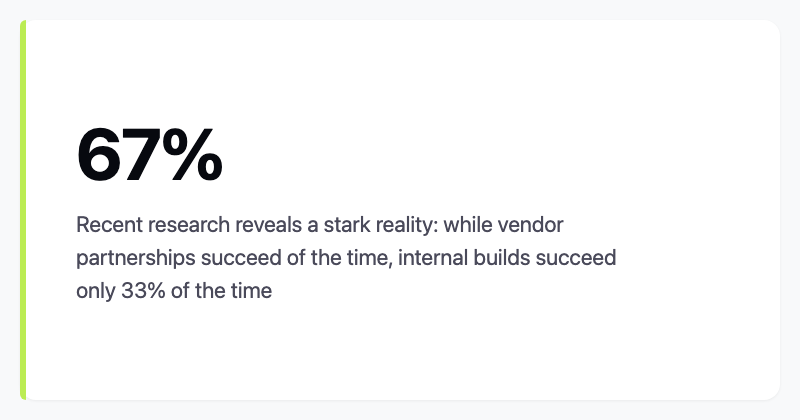
The build vs buy for AI screening decision costs organizations millions in wasted resources when approached with the wrong framework. Recent research reveals a stark reality: while vendor partnerships succeed 67% of the time, internal builds succeed only 33% of the time. This isn't just about technology—it's about understanding incentives and managing relationships in a market where information asymmetry creates perfect conditions for poor decisions.
The Principal-Agent Problem in AI Screening
Vendor sales teams and your organization have fundamentally different incentives. This principal-agent dynamic shapes every conversation about build vs buy for AI screening.
Hidden Costs of Vendor Relationships
Vendors succeed when you pay annual subscriptions, not when your hiring efficiency improves. The SaaS model costs $9,100 per employee annually, creating a persistent incentive for vendors to keep you dependent rather than independent.
"The vendor's business model thrives on your ongoing need, not your eventual self-sufficiency."
This creates a fundamental misalignment: your success metrics (hiring speed, quality, cost) differ from theirs (recurring revenue, expansion, retention). The result is a relationship that benefits the vendor first, even when it appears to serve your needs.
The Illusion of Control in Builds
When organizations choose to build in-house AI screening solutions, they often overestimate their control while underestimating the hidden costs. Research shows 95% of enterprise AI projects fail, with most organizations abandoning builds after 18 months.
Building requires:
- Specialized engineering talent pulled from other priorities
- Ongoing maintenance costs that exceed initial projections
- Compliance risks in an increasingly regulated environment
- Technology debt that accumulates faster than expected
The Economic Reality of AI Screening
Market failures in the AI screening space create conditions where neither pure build nor pure buy makes optimal sense. Understanding these failures helps design better solutions.
Information Asymmetry in Vendor Selection
Vendors know their products' limitations better than you do during the sales process. This information asymmetry leads to:
- Overpromised capabilities
- Implementation challenges that emerge post-purchase
- Customization needs that trigger additional fees
The principal-agent problem is particularly acute because the vendor possesses information about their product's true limitations while you must operate on incomplete information.
Opportunity Cost of Internal Builds
When engineers build custom AI screening tools, they aren't building other strategic initiatives. The opportunity cost often exceeds the direct development expenses by a factor of 3-5.
Consider what your engineering team could accomplish with those resources:
- Improving your core product
- improving candidate experience directly
- Building complementary tools that address your specific hiring challenges
The Middle Path: Strategic Hybrid Approaches
The most successful organizations recognize that build vs buy for AI screening isn't a binary choice. They create hybrid models that use vendor capabilities while maintaining strategic control.
Borrowing and Bridging Strategies
The "borrow, bridge, build" framework offers a more nuanced approach than traditional build vs buy decisions:
- Borrow: Implement vendor solutions for standardized screening needs
- Bridge: Develop lightweight integration layers between systems
- Build: Create highly specialized components that solve unique problems
This approach reduces the risk profile while maintaining flexibility. Organizations using this method report 40% higher success rates than those pursuing pure build or buy strategies.
Phased Implementation Frameworks
Successful AI screening implementation follows a phased approach:
- Assessment: Map your specific screening challenges against vendor capabilities
- Pilot: Test vendor solutions with limited scope before full commitment
- Integration: Build custom connectors rather than entire systems
- Optimization: Use vendor data to identify areas for internal improvement
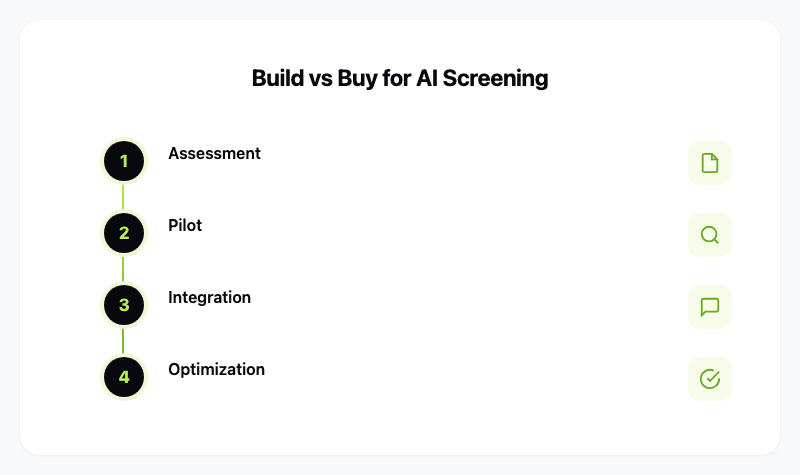
This phased approach reduces the risk of both vendor lock-in and failed builds by creating checkpoints for evaluation and adjustment.
Evaluating Vendor Claims
Vendor presentations often present a simplified version of build vs buy for AI screening. Your evaluation process must dig deeper to uncover the true costs and benefits.
Beyond the Sales Deck
When evaluating vendor claims:
- Ask for implementation case studies, not just success stories
- Request references with similar screening volumes and complexity
- Insist on clear metrics for what "success" looks like
- Understand what happens if you need to change vendors
The most important question isn't "Can this tool solve our screening problems?" but "What happens when this tool fails to meet expectations?"
Total Cost of Ownership Calculations
Organizations consistently underestimate the total cost of ownership for vendor solutions. Consider:
- Implementation and customization costs
- Data migration expenses
- Training and change management
- Ongoing maintenance and support fees
- Potential upgrade costs when vendors sunset features
A comprehensive TCO analysis should include these factors across a 3-5 year horizon, not just the annual subscription fee.
Making the Decision Framework
The build vs buy decision for AI screening requires a framework that accounts for your specific context, capabilities, and constraints.
Screening Complexity Assessment
Not all screening challenges are equal. Map your requirements:
- Standardized roles with clear criteria: Vendor solutions often excel here
- Highly specialized roles with nuanced requirements: Custom components may be necessary
- High-volume roles requiring speed: Vendor platforms typically offer advantages
- Compliance-sensitive roles: May require custom validation layers
This mapping helps allocate resources appropriately across build and buy decisions.
Capability Inventory
Assess your internal capabilities honestly:
- Do you have data science expertise to train and maintain AI models?
- Can you dedicate engineering resources to ongoing maintenance?
- Do you have the compliance expertise to ensure regulatory requirements?
- Can you measure and attribute hiring improvements accurately?
Organizations that pursue build without these capabilities consistently fail to achieve expected ROI.
The Future of AI Screening
The AI screening landscape continues to evolve, with implications for your build vs buy strategy.
The End of Per-Seat Licensing
2026 marks the end of the per-seat licensing era. Organizations are shifting toward:
- Outcome-based pricing models
- Usage-based pricing structures
- Platform approaches rather than point solutions
This shift changes the economic calculus of vendor relationships, potentially reducing the cost advantage of builds while maintaining the strategic benefits of hybrid approaches.
Talent as a Strategic Differentiator
As AI screening becomes commoditized, the organizations that succeed will be those that use these tools to improve rather than replace human judgment. The most effective approach combines:
- Vendor AI for initial screening
- Human expertise for nuanced evaluation
- Custom analytics for continuous improvement
This human-AI partnership creates a screening system that's both efficient and effective, using the strengths of each approach.
Your Decision Framework for Monday Morning
When evaluating build vs buy for AI screening, ask three questions:
- What specific screening capabilities create competitive advantage for us?
- Where can vendor solutions provide 80% of the value for 20% of the cost?
- How can we structure our approach to maintain flexibility regardless of which path we choose?
The optimal solution isn't pure build or pure buy—it's a strategic approach that allocates resources where they create the most value while maintaining the flexibility to adapt as the market evolves.